Budget
$38/m² + GSTTuff Floor 51 · 2 water-based coats
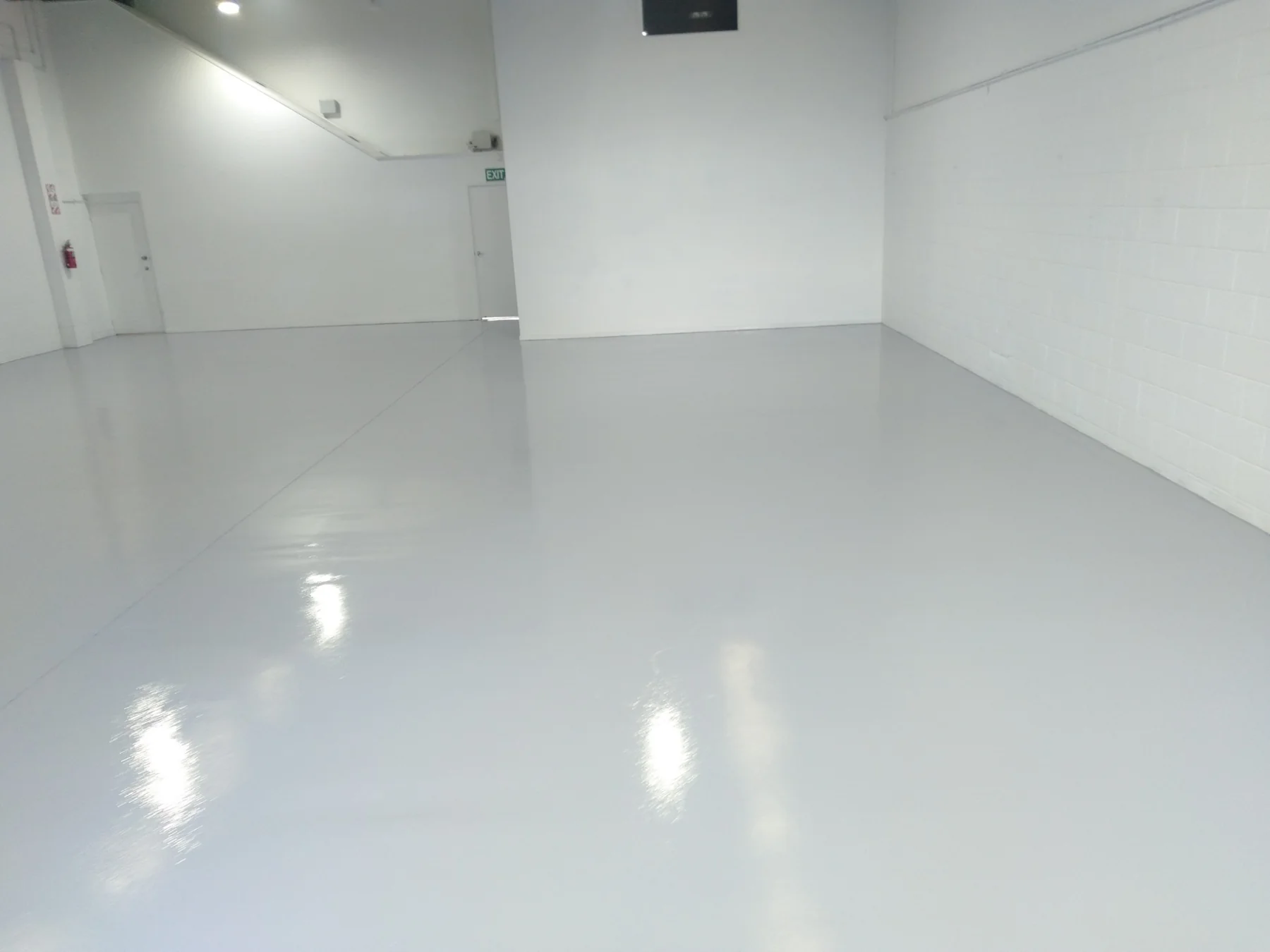
Two coloured water-based epoxy coats direct to prepared concrete. Thin, economical and able to tolerate low levels of moisture vapour movement.

From economical water-based roll coats to industrial-grade self-levelling epoxy systems used for garages, workshops, factories and warehouses.
Prices below are coating components + GST. Standard preparation is additional unless stated otherwise.
Two coloured water-based epoxy coats direct to prepared concrete. Thin, economical and able to tolerate low levels of moisture vapour movement.
Water-based primer/sealer followed by two coloured coats. A polyurethane final coat can be used where greater abrasion resistance is wanted.
Solvent-free epoxy roll coats at higher build than typical water-based coatings.
Primer followed by two solvent-free epoxy roll coats for more build and protection.
A heavier-build self-levelling system also used for factories, warehouses and workshops. It can smooth damaged concrete while providing much greater film thickness and impact protection.
Quartz can be broadcast into the resin to increase build and slip resistance. The textured surface also increases topcoat resin consumption.
NZ manufactured: the Tuff Floor epoxy system we use is locally manufactured in New Zealand.
A thicker system gives you more resin to wear through and generally lasts longer under demanding use. Greater build also helps absorb impact, reducing the chance of an impact fracturing the coating or damaging the concrete underneath.
Chips, dings, pitting and small depressions can remain visible through thin coatings. A self-levelling epoxy can fill and smooth those defects to create a more uniform base.
We can use epoxy as the base or mid-layer where the floor needs build and levelling, then finish with a polyaspartic topcoat for higher abrasion resistance, improved chemical resistance, UV stability and faster return to service.
This lets each resin do the job it is best suited to rather than forcing the entire floor into one material.
We diamond grind the slab, repair defects and vacuum thoroughly before coating. Professional dust extractors are connected directly to our grinders to help control dust during preparation.
Typically from $20/m² + GST where normal grinding is sufficient. Coating removal, floor-covering removal, heavy repairs, levelling and moisture treatment are additional where required.
Tuff Floor 51 with two water-based coloured coats is the lowest-cost epoxy build in this guide. Standard preparation, job size and any repairs still affect the final price.
It is the same type of heavier-build epoxy approach we use for demanding factory, warehouse and workshop floors. The resin is installed at substantially greater thickness than a thin roll coat, giving more protection and impact resistance.
More thickness means more material to wear through and a greater ability to absorb impact before the coating fractures or damage reaches the concrete substrate.
Yes. We can use epoxy as a base or build layer to smooth and strengthen the floor, then apply polyaspartic as the wear layer for higher abrasion resistance, improved chemical resistance, UV stability and faster return to use.
Yes. Polyaspartic is an excellent wear surface but is not intended to disguise a badly damaged slab. A self-levelling epoxy layer can fill chips, dings and minor depressions first, creating a smoother surface for the final wear coat.
Yes. The Tuff Floor epoxy system we use is locally manufactured in New Zealand.
You don't need to know the exact area or which resin system you need. Give us the basics and we'll narrow down the suitable options.